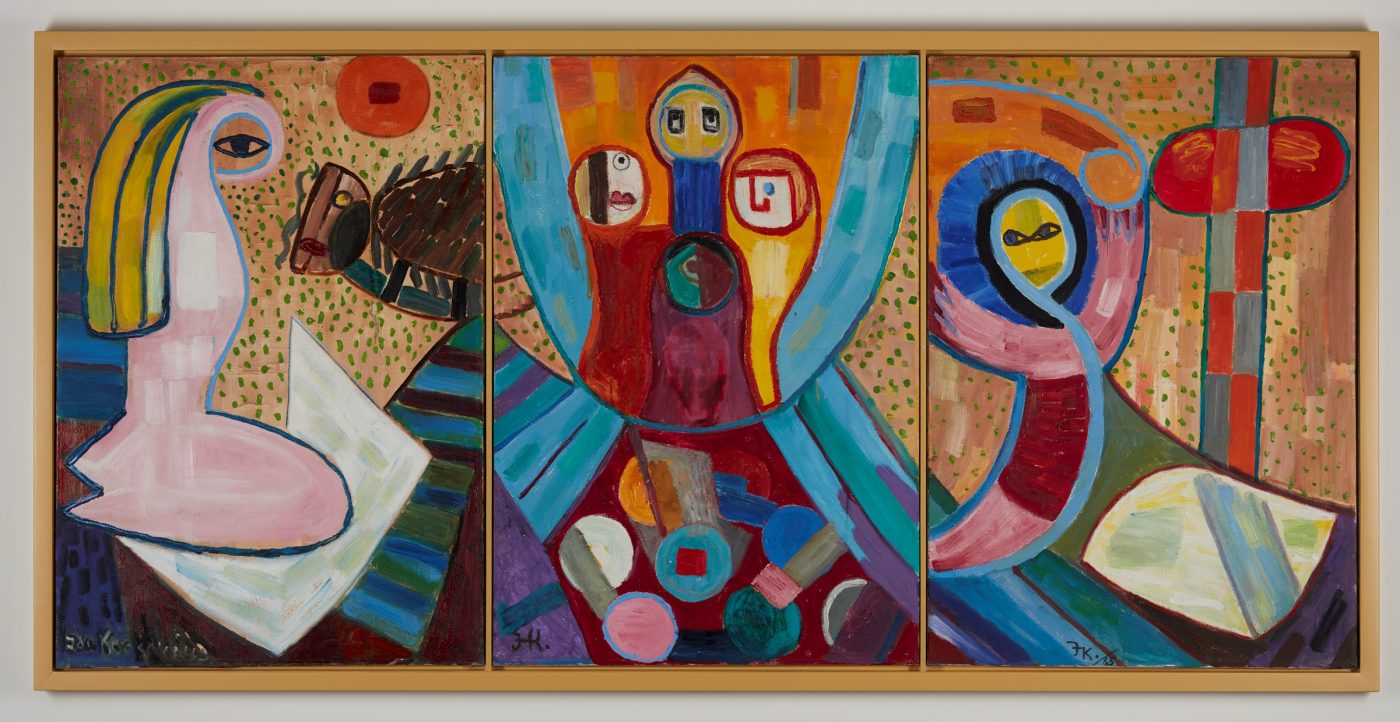
Ida Kerkovius provides like Oskar Schlemmer and Johannes Itten a bridge from Hölzel to the Bauhaus. She was working in Hölzel’s master-class and taught Johannes Itten for a brief period in 1913. Then, Kerkovius attended the prep course at the Bauhaus in her turn seven years later. She worked in Klee’s and Kandinsky’s painting classes and in the weaving department at the same time. Kerkovius was closely linked with Hölzel as a friend and colleague until he died, just as her work fed on her teacher’s powerful use of color and religiously permeated figure concepts throughout her lifetime. A key work from the artist’s late oeuvre is the Triptychon of 1965, comparable to a winged altar. The religious theme could refer to the biblical figures of the three Marie’s under the cross. On the left, we possibly see a depiction of Mary of Clopas, the sister of the Virgin Mother, with a shroud on the ground; the central panel may show Mary’s ascension in a kind of aureola with two angels. The right panel may depict Mary Magdalene who watches over Jesus Christ’s empty grave; the resurrected Jesus Christ appears to her on the right, giving her the message that he will ascend to His Father and His God.
close
checkout*
Shopping cart
Versand und Abwicklung erfolgt über die Bücherbogen am Savignyplatz GmbH in Berlin. Für Fragen zu Bestellungen wenden Sie sich bitte direkt an info@buecherbogen.com
Handling and Shipping is done by theBücherbogen am Savignyplatz GmbH in Berlin. For questions regarding your order please contact info@buecherbogen.com directly.
*
Bestellungen aus der EU sind bei PayPal auch ohne Anmeldung möglich. Sie können dann auch bequem per Bankeinzug oder mit Ihrer Kreditkarte zahlen.
Für diese Option klicken Sie bitte auf PayPal und wählen anschließend die Bezahlung "Mit Lastschrift oder Kreditkarte" aus.
Buyers from within the EU can use PayPal even without having a PayPal account.
Via Paypal you can also check out with direct debit or with your credit card.
For this option please click on "Check out with PayPal" and make use of the "Payment by Direct Debit or Credit Card".